

Aircraft Branding Decal Systems Industry Outlook: Market Expansion and Price Trend Analysis (2026–2036)
Rising demand for rapid aircraft rebranding and reduced downtime accelerates adoption of high-performance decal systems across global aviation fleets
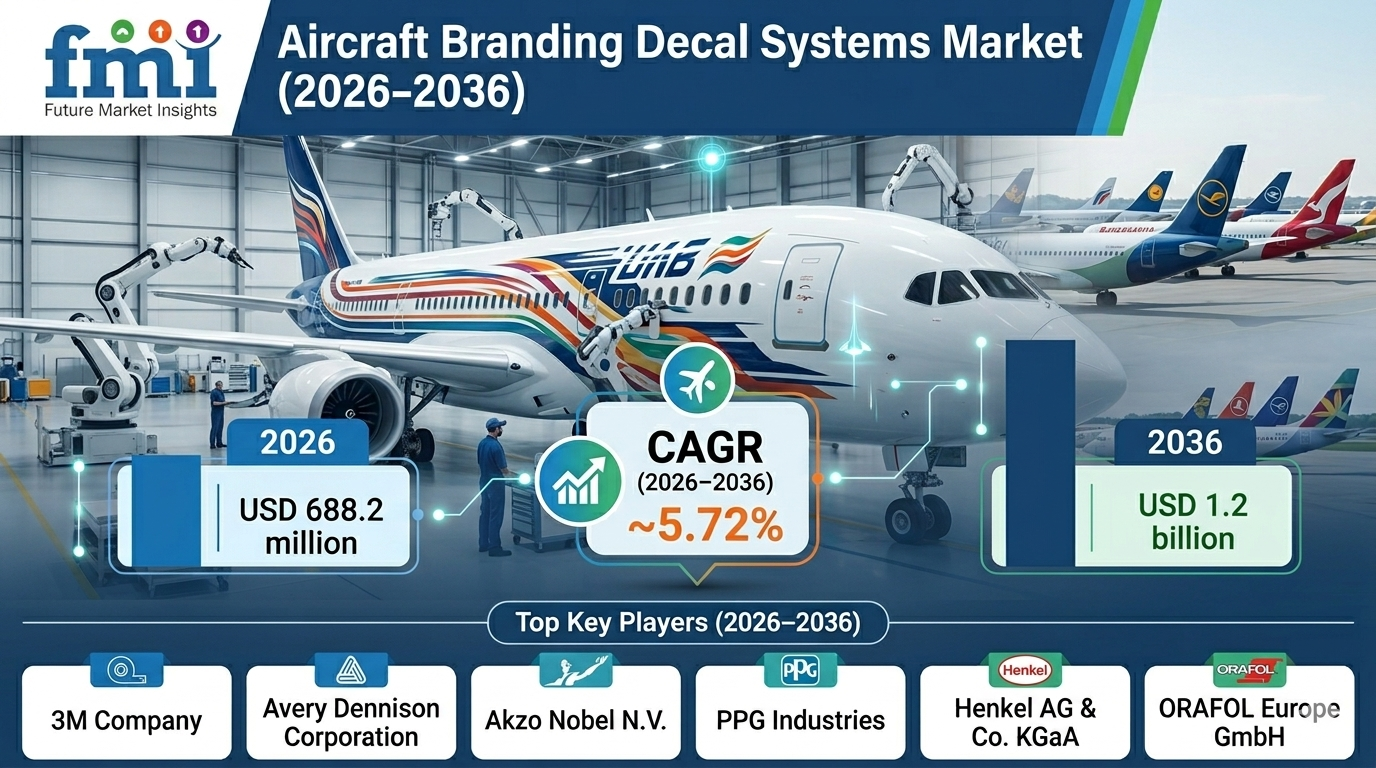
NEWARK, DE, UNITED STATES, March 24, 2026 /EINPresswire.com/ -- The global Aircraft Branding Decal Systems Market is valued at USD 688.2 million in 2026 and is projected to reach USD 1.2 billion by 2036, expanding at a CAGR of 5.72% during the forecast period. Growth is driven by increasing aircraft leasing cycles, rising pressure to minimize operational downtime, and the aviation industry’s shift toward flexible, cost-efficient branding solutions.
As airlines and lessors prioritize asset utilization and turnaround efficiency, decal systems are rapidly replacing traditional paint-based liveries. These systems are evolving from simple branding tools into critical components of aircraft lifecycle management, enabling faster transitions between operators and reducing revenue loss from grounded aircraft.
Aircraft Branding Decal Systems Market Snapshot (2026–2036)
• Market size in 2026: USD 688.2 million
• Market size in 2036: USD 1.2 billion
• CAGR (2026–2036): ~5.72%
• Leading segment: External decals
• Top material type: Pressure-sensitive adhesives
• Dominant end-use: Commercial aviation
• Fastest-growing country: India
• Key companies: Aerospace material and adhesive film manufacturers
Market Momentum
The Aircraft Branding Decal Systems Market begins at USD 688.2 million in 2026, supported by the growing need for rapid aircraft rebranding amid shorter lease cycles. Between 2027 and 2030, increased adoption among low-cost carriers and leasing companies accelerates demand, particularly for narrow-body fleets with high utilization rates.
Entering 2032 and beyond, advancements in adhesive technologies, digital print-to-film workflows, and sustainability-driven material innovation strengthen market expansion. By 2036, the market reaches USD 1.2 billion, as decal systems become standard in fleet maintenance and branding strategies worldwide.
Request For Sample Report | Customize Report |purchase Full Report - https://www.futuremarketinsights.com/reports/sample/rep-gb-32321
Why the Market is Growing
The market is expanding due to a structural shift in how airlines manage aircraft assets. Traditional paint-based liveries require extended hangar time, specialized facilities, and high operational costs. In contrast, decal systems enable faster, “on-gate” or overnight application, significantly reducing downtime.
Aircraft leasing dynamics also play a critical role. As nearly half of the global fleet operates under lease agreements, frequent transitions between operators necessitate quick livery neutralization and rebranding. Decal systems provide a flexible and efficient solution, allowing aircraft to return to service rapidly.
Additionally, sustainability considerations are influencing adoption. Decal systems reduce the need for chemical-intensive paint stripping processes and offer lower environmental impact during removal, aligning with evolving regulatory standards.
Segment Spotlight
1. Decal Type: External Decals Lead Demand
External decals account for approximately 62.4% of the market, driven by regulatory requirements for aircraft registration markings, branding visibility, and safety compliance. These decals are essential for aircraft certification and operation.
2. Material Type: Pressure-Sensitive Adhesives Dominate
Pressure-sensitive adhesives represent around 54.8% of the market, as they allow easy application, repositioning, and residue-free removal. These systems eliminate the need for heat-based installation, reducing complexity and labor costs.
3. End Use: Commercial Aviation Holds Majority Share
Commercial aviation dominates through 2036, supported by the high volume of narrow-body aircraft and the growing influence of low-cost carriers that prioritize rapid branding and operational efficiency.
Drivers, Opportunities, Trends, Challenges
Drivers:
• Increasing aircraft leasing and asset transitions
• Need to minimize aircraft downtime
• Growth of low-cost carrier fleets
Opportunities:
• Digital print-to-decal workflows
• Smart sensing films integrated into aircraft surfaces
• Sustainable, solvent-free removal technologies
Trends:
• Shift toward lifecycle-based fleet management
• Integration of decals in initial aircraft design
• Growing preference for modular and replaceable branding systems
Challenges:
• Adhesive residue and “ghosting” on older paint surfaces
• Certification requirements for aviation-grade materials
• Compatibility with diverse aircraft coating systems
Country Growth Outlook (2026–2036)
India leads growth at a projected CAGR of 8.2%, driven by rapid expansion of low-cost carriers and large aircraft order backlogs. China follows at 7.8%, supported by domestic route expansion and fleet modernization. The UAE registers 6.1% growth due to its role as a global aviation hub, while Brazil grows at 5.4% with strong regional airline activity.
The United States maintains steady growth at 4.5%, supported by a mature aviation ecosystem and large aftermarket demand. Germany (3.8%) and Japan (3.2%) show stable expansion driven by regulatory compliance and precision-focused maintenance practices.
Competitive Landscape
The market is characterized by a concentrated group of aerospace-certified material providers competing on adhesive performance, durability, and ease of removal. Key players focus on developing advanced polymer films that ensure long-term reliability under extreme flight conditions.
Competition increasingly centers on “clean-strip” adhesive technologies, compatibility with modern aircraft coatings, and integration with digital printing systems. Strategic partnerships with airlines, MRO providers, and aircraft manufacturers are critical for long-term market positioning.
Leading companies include 3M Company, Avery Dennison Corporation, Akzo Nobel N.V., PPG Industries, Henkel AG & Co. KGaA, and ORAFOL Europe GmbH.
Frequently Asked Questions (FAQ)
What is the global Aircraft Branding Decal Systems Market size?
The market is valued at USD 688.2 million in 2026 and is projected to reach USD 1.2 billion by 2036.
At what rate is the market expected to grow?
The market is forecast to expand at a CAGR of approximately 5.72% from 2026 to 2036.
What are aircraft branding decal systems?
They are specialized adhesive-backed films used for aircraft exterior and interior markings, offering a lightweight and time-efficient alternative to traditional paint.
Why are decal systems gaining importance in aviation?
They enable faster rebranding, reduce aircraft downtime, support leasing transitions, and provide a more sustainable alternative to conventional paint-based liveries.
Explore More Related Studies Published by FMI Research:
Polysulfide Market: https://www.futuremarketinsights.com/reports/polysulfide-market
Joint Compound Market: https://www.futuremarketinsights.com/reports/joint-compound-market
Fire-Retardant Additives for PCR Electronics Market: https://www.futuremarketinsights.com/reports/fire-retardant-additives-for-pcr-electronics-market
About Future Market Insights (FMI)
Fture Market Insights, Inc. (FMI) is an ESOMAR-certified, ISO 9001:2015 market research and consulting organization, trusted by Fortune 500 clients and global enterprises. With operations in the U.S., UK, India, and Dubai, FMI provides data-backed insights and strategic intelligence across 30+ industries and 1200 markets worldwide.
Why Choose FMI: https://www.futuremarketinsights.com/why-fmi
Sudip Saha
Future Market Insights Inc.
+1 347-918-3531
rahul.singh@futuremarketinsights.com
Legal Disclaimer:
EIN Presswire provides this news content "as is" without warranty of any kind. We do not accept any responsibility or liability for the accuracy, content, images, videos, licenses, completeness, legality, or reliability of the information contained in this article. If you have any complaints or copyright issues related to this article, kindly contact the author above.
