

Dual quasi-BIC resonances synergized laser cooling in halide perovskite metasurface
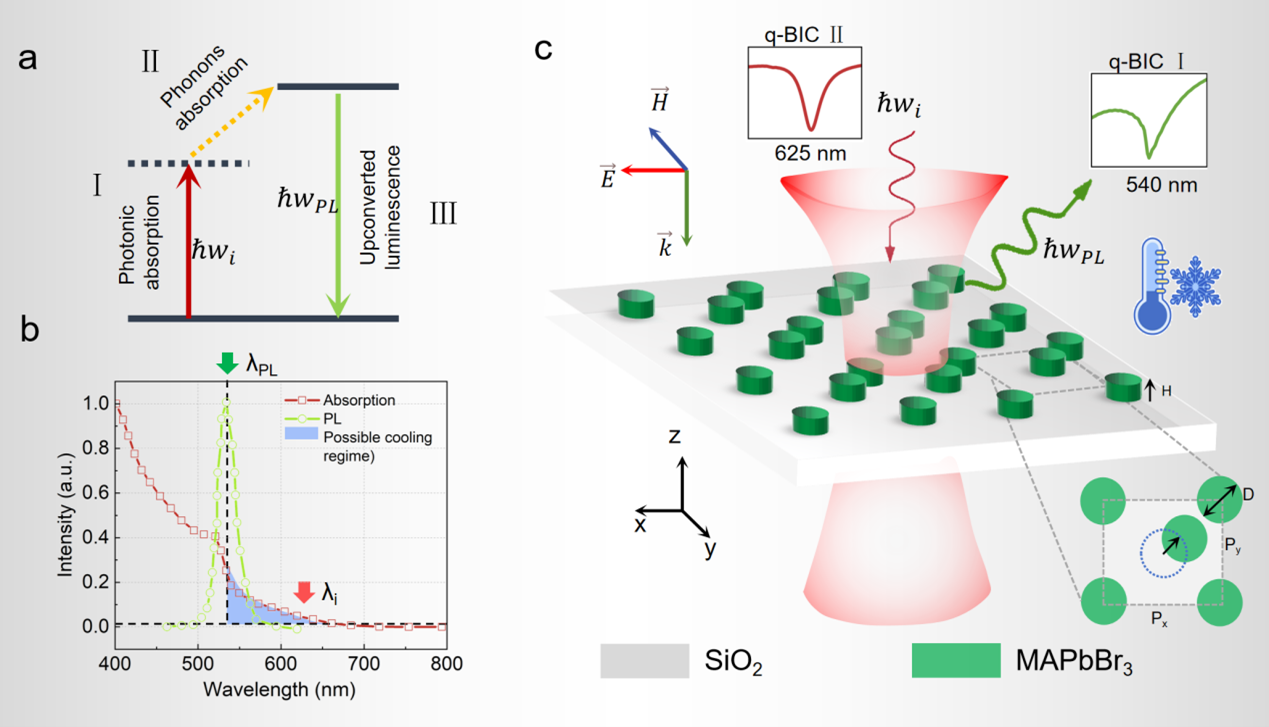
Figure 1. Schematic of laser refrigeration using a dual-band q-BIC perovskite metasurface.
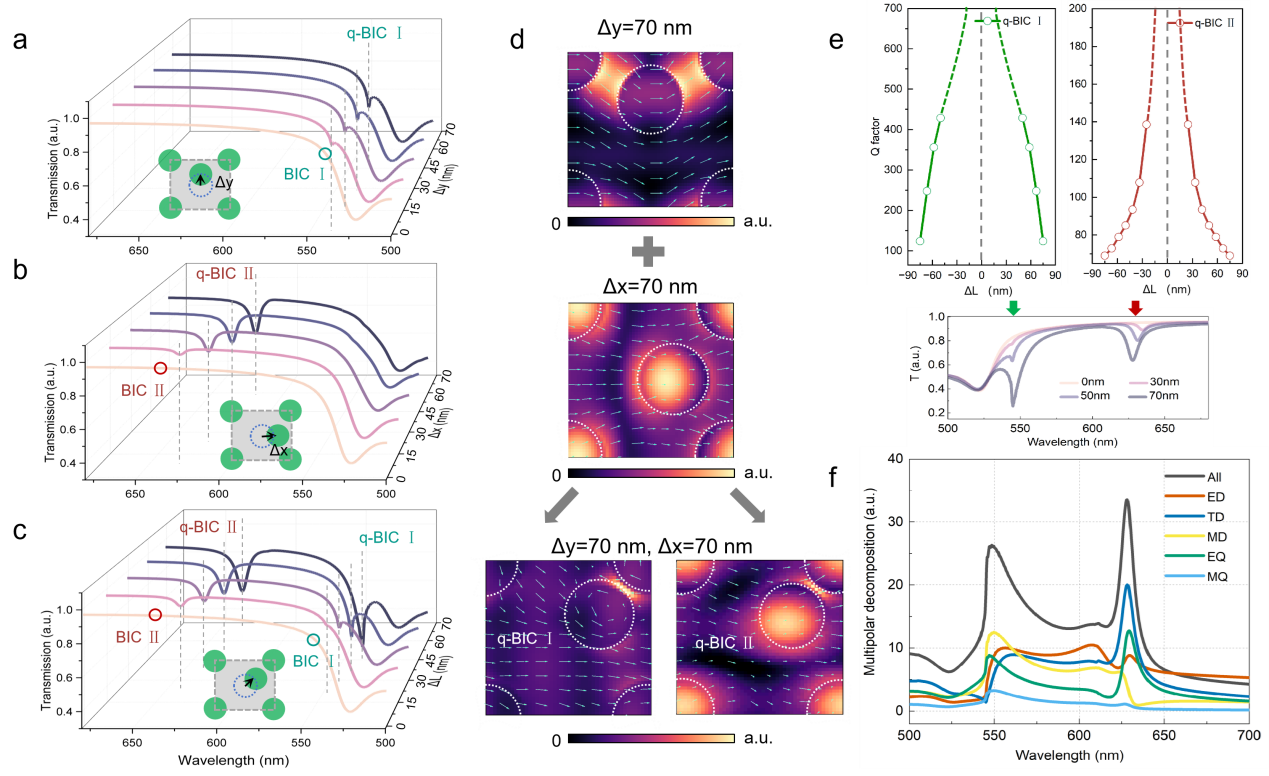
Figure 2. Schematic illustrating the formation mechanism of dual-wavelength q-BIC modes.
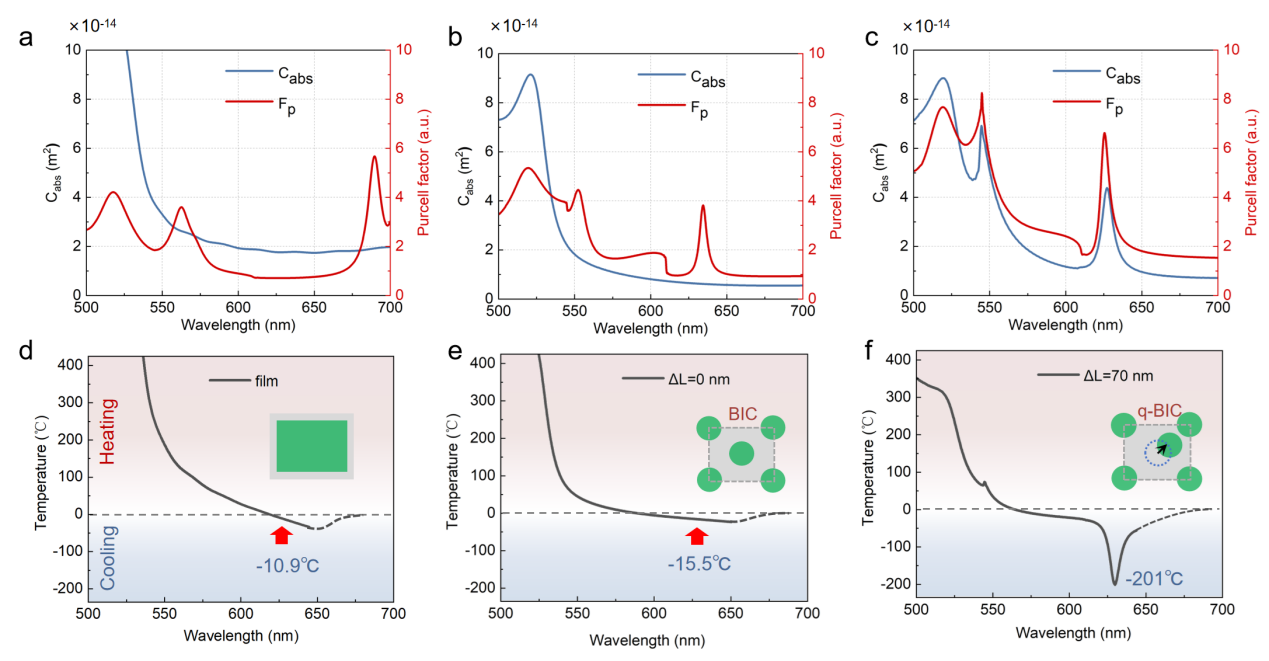
Figure 3. Absorption/radiative enhancement and the corresponding refrigeration performance for the perovskite film, the symmetric BIC metasurface, and the dual q-BIC metasurface, showing that the dual q-BIC design achieves the deepest net cooling.
New publication in OET, DOI 10.29026/oet.2026.250013, discusses dual quasi-BIC resonances synergized laser cooling in halide perovskite metasurface
SHANNON, CLARE, IRELAND, April 6, 2026 /EINPresswire.com/ -- A new publication from Opto-Electronic Technology; DOI 10.29026/oet.2026.250013, discusses dual quasi-BIC resonances synergized laser cooling in halide perovskite metasurface.
Laser refrigeration cools materials through light–matter interactions, offering a low-vibration, integration-friendly alternative to conventional mechanical cooling. Achieving a large, stable temperature drop is difficult because net cooling requires anti-Stokes fluorescence: the material absorbs pump photons, draws additional energy from lattice phonons, and re-emits higher-energy (shorter-wavelength) photons that carry heat away. In practice, this demands not only strong pump absorption but also near-unity radiative efficiency within the cooling window, while parasitic absorption, nonradiative recombination, and carrier thermalization must be minimized; otherwise, the absorbed energy turns into heat and cancels the cooling effect. Halide perovskites, with high luminescence efficiency, tunable bandgaps, and compatibility with low-temperature processing and micro/nanostructuring, are a promising platform for anti-Stokes cooling. A central challenge is to enhance both pump absorption and the anti-Stokes radiative channel at the micro/nanoscale while suppressing losses, paving the way toward practical, integrated perovskite laser coolers.
To overcome two long-standing bottlenecks in solid-state optical refrigeration, limited pump absorption and constrained radiative efficiency, the authors of this article propose a halide-perovskite metasurface strategy based on dual quasi-bound states in the continuum (q-BICs).
By precisely engineering an asymmetric displacement in a MAPbBr₃ perovskite nanodisk array, the researchers realized two independently tunable q-BIC resonances within a single metasurface. The long-wavelength mode (~625 nm) is spectrally matched to the absorption edge, enabling markedly enhanced pump absorption, while the short-wavelength mode (~540 nm) aligns with the photoluminescence peak and benefits from Purcell enhancement to accelerate radiative recombination. Together, these dual resonances enable simultaneous optimization of the absorption–emission cycle, offering a new structural route to improve laser-cooling efficiency. Coupled carrier-dynamics and thermodynamic modeling predicts an external quantum efficiency as high as 98.8% under continuous-wave excitation, well above the threshold required for anti-Stokes fluorescence cooling. Further thermodynamic simulations predict net cooling from room temperature down to −201 °C, extending below the liquid-nitrogen temperature range.
This work shows that resonance engineering and spectral matching can substantially improve anti-Stokes optical refrigeration in halide perovskites without changing the material itself, providing an integrable and low-vibration route toward cryogenic solid-state cooling. The dual q-BIC scheme also serves as a transferable, structure-based design strategy at the interface of nanophotonics and thermal management, and it can be extended to other high-index dielectric platforms. Potential applications include miniaturized temperature control for vibration-sensitive systems such as densely integrated photonic circuits, quantum photonic devices, and space instrumentation.
This work was supported by the National Key R&D Program of China (2024YFA1209301, 2022YFB3607300); the National Natural Science Foundation of China (NSFC) (62075084, 62325503, 62005104, 12404432,62575032 and 62475102); the Guangdong Province Basic and Applied Basic Research Foundation (2025A1515012110); the Fund of State Key Laboratory of Information Photonics and Optical Communications (BUPT) (2024ZT03), P. R. China; and the China Postdoctoral Science Foundation (2025M770804).
Keywords: laser cooling, bound states in the continuum, perovskite metasurfaces
# # # # # #
The Nanophotonics and Devices Group (NPD Group) at the School of Physics and Optoelectronic Engineering, Jinan University, is led by Prof. Xiangping Li, an Optica Fellow and recipient of the National Science Fund for Distinguished Young Scholars. The group carries out research in nanophotonics and metasurfaces, super-resolution light-field manipulation, laser micro/nanofabrication, and multidimensional optical data storage. The team has produced a series of representative advances in the field of nanophotonics, with publications in Science, Nature Photonics, Nature Nanotechnology, and Nature Communications, and has established a portfolio of core intellectual property and patents, with some outcomes advanced through technology transfer and collaborations. The group has published more than 150 SCI-indexed papers with over 10,000 citations, and some achievements have been selected for recognitions such as the “Top Ten Advances in Chinese Optics” and featured in NSFC annual reports. Group website: https://npdgroup.jnu.edu.cn/.
# # # # # #
Opto-Electronic Technology (OET) is an international, peer-reviewed and open access English language journal. OET publishes reviews, research articles and letters covering engineering technologies and applications of optics, photonics and optoelectronics.
# # # # # #
More information: https://www.oejournal.org/oet/en/
Editorial Board: https://www.oejournal.org/oet/en/editorial_board/oetEditorialBoard
All issues available in the online archive (https://www.oejournal.org/oet/archive_list_en)
Submission of OET may be made using ScholarOne (https://mc03.manuscriptcentral.com/oet)
ISSN (Print) 2097-6003
CN 51-1811/O4
Contact Us: oet@ioe.ac.cn
Twitter: @OptoElectronAdv (https://twitter.com/OptoElectronAdv?lang=en)
WeChat: OE_Journal
# # # # # #
Che Y, Lu P, Li Y et al. Dual quasi-BIC resonances synergized laser cooling in halide perovskite metasurface. Opto-Electron Technol 2, 250013 (2026). DOI: 10.29026/oet.2026.250013
Opto-Electronic Technology Editorial Office
Opto-Electronic Technology
email us here
123456789
Legal Disclaimer:
EIN Presswire provides this news content "as is" without warranty of any kind. We do not accept any responsibility or liability for the accuracy, content, images, videos, licenses, completeness, legality, or reliability of the information contained in this article. If you have any complaints or copyright issues related to this article, kindly contact the author above.
