

Global Breast Cancer Diagnostics Market 2026–2036: Regional Dominance & Key Players like Roche, Thermo Fisher Scientific
Breast Cancer Diagnostics Market
AI-Powered Imaging, Reimbursement Expansion, and Molecular Diagnostics Reshape Market Trajectory Toward USD 12.45 Billion by 2036
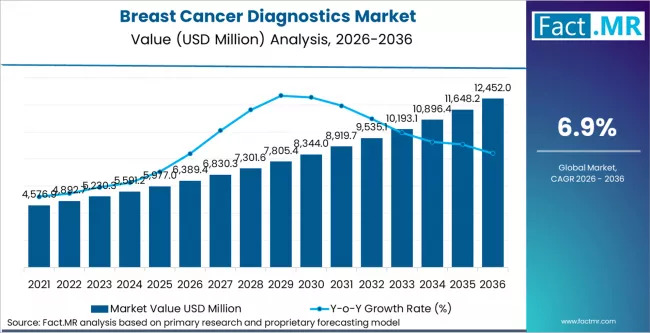
ROCKVILLE, MD, UNITED STATES, April 9, 2026 /EINPresswire.com/ -- According to the latest analysis by Fact.MR, the global breast cancer diagnostics market is valued at USD 6,389.41 million in 2026, up from USD 5,878 million in 2025, and is forecast to reach USD 12,451.97 million by 2036, expanding at a CAGR of 6.9%.Get detailed market forecasts, competitive benchmarking, and pricing trends: https://www.factmr.com/connectus/sample?flag=S&rep_id=55
The market is set to generate an incremental opportunity of USD 6,063 million over the forecast period (2026–2036), reflecting sustained structural demand.
This transformation is being driven by:
Mandatory biomarker testing guidelines
Expansion of reimbursement frameworks
Rapid adoption of AI-enabled diagnostic technologies
Shift toward multi-analyte and precision oncology platforms
Quick Stats
Market Size (2026): USD 6,389.41 million
Market Size (2027 est.): ~USD 6,830 million
Forecast Value (2036): USD 12,451.97 million
CAGR (2026–2036): 6.9%
Incremental Opportunity: USD 6,063 million
Leading Segment: Invasive Ductal Carcinoma (40.0% share)
Leading Disease Stage: Stage 2 (31.0% share)
Leading Region: North America
Key Players: Hologic Inc., Roche Diagnostics, Siemens Healthineers AG, GE HealthCare, Abbott Laboratories
Executive Insight for Decision Makers
The market is undergoing a structural shift from price-driven procurement to compliance-driven purchasing.
Strategic Imperatives:
Secure regulatory approvals and reimbursement coverage early
Invest in clinical evidence and real-world data
Expand AI-integrated diagnostic capabilities
Prioritize high-growth markets like India and Germany
Risk of Inaction:
Exclusion from institutional procurement frameworks
Loss of competitive positioning due to lack of guideline compliance
Reduced pricing power in premium diagnostic segments
Market Dynamics
Key Growth Drivers
Regulatory Mandates: Biomarker and companion diagnostics becoming standard-of-care
Rising Cancer Incidence: Increasing global breast cancer burden
Technology Advancements: AI, liquid biopsy, and genomic profiling
Reimbursement Expansion: Government-backed oncology coverage programs
Key Restraints
Complex Reimbursement Systems across countries
High Cost of Advanced Diagnostics
Regulatory Compliance Burden for new entrants
Emerging Trends
AI-assisted mammography and pathology
Liquid biopsy for non-invasive detection
Multi-gene panel testing (e.g., prognostic assays)
Shift toward personalized oncology diagnostics
Segment Analysis
Leading Segment:
Invasive Ductal Carcinoma (IDC) holds 40.0% share (2026)
Driven by high prevalence and multiple biomarker testing requirements
Leading Disease Stage:
Stage 2 accounts for 31.0% share, due to extensive diagnostic protocols
Fastest-Growing Segment:
Molecular diagnostics & genomic testing, fueled by precision medicine adoption
Strategic Importance
Multi-gene testing significantly increases revenue per patient
Early-stage detection technologies expand screening volumes
AI integration enhances diagnostic efficiency and scalability
Supply Chain Analysis (Critical Insight)
Value Chain Structure
Raw Material Suppliers
Reagents, antibodies, imaging components, semiconductor chips
Manufacturers / Producers
Diagnostic device companies (imaging systems, biopsy tools)
Molecular diagnostics firms (kits, genomic panels)
Distributors
Medical device distributors
Hospital procurement networks
Government tenders and centralized purchasing bodies
End-Users
Hospitals and oncology centers
Diagnostic laboratories
Research institutes
“Who Supplies Whom”
Reagent suppliers → Diagnostic manufacturers
Manufacturers → Hospitals & labs (via distributors)
Hospitals → Patients (diagnostic services)
Key Insight:
Vendor consolidation is increasing, with hospitals preferring integrated solution providers offering imaging + diagnostics + software ecosystems.
Pricing Trends
Commodity vs Premium Pricing
Basic imaging: price-sensitive
Molecular diagnostics & AI tools: premium-priced
Key Influencing Factors
Regulatory certifications (FDA, IVDR)
Reimbursement eligibility
Technology sophistication
Volume-based procurement contracts
Margin Insights
Higher margins in genomic testing and AI software
Lower margins in hardware-heavy imaging systems
Recurring revenue from consumables and test kits
Regional Analysis
Top 5 Countries by CAGR (2026–2036)
India: 10.8%
Germany: 9.9%
France: 9.0%
UK: 8.2%
USA: 7.5%
Growth Drivers by Region
India: Expanding insurance coverage and diagnostic standardization
Germany: Strict guideline mandates and IVDR compliance
France: Government-backed molecular profiling programs
UK: Genomic medicine integration
USA: Strong reimbursement ecosystem and innovation pipeline
Developed vs Emerging Markets
Developed Markets:
High adoption of advanced diagnostics
Stable but moderate growth
Emerging Markets:
Rapid infrastructure development
Higher CAGR due to expanding access
Competitive Landscape
Market Structure: Moderately consolidated, moving toward consolidation
Key Players
Hologic Inc.
Roche Diagnostics
Siemens Healthineers AG
GE HealthCare
Philips Healthcare
Abbott Laboratories
Becton Dickinson and Company
Thermo Fisher Scientific Inc.
Fujifilm Holdings Corporation
Agilent Technologies Inc.
Competitive Strategies
AI-enabled product innovation
Expansion of diagnostic portfolios
Strategic partnerships with hospitals
Geographic expansion in emerging markets
Pricing optimization through bundled offerings
Strategic Takeaways
For Manufacturers
Focus on integrated diagnostic ecosystems
Invest in AI and molecular diagnostics platforms
For Investors
Target high-growth regions (India, Europe)
Back companies with strong regulatory pipelines
For Marketers / Distributors
Emphasize clinical validation and compliance
Build relationships with institutional buyers
Future Outlook
The market is heading toward a fully integrated, AI-driven diagnostic ecosystem.
Key Future Trends
AI-powered early detection systems
Home-based and remote diagnostics
Genomic sequencing for personalized treatment
Expansion of liquid biopsy applications
Long-Term Opportunity
Significant value creation in precision oncology diagnostics
Growth in digital pathology and telemedicine integration
Unlock 360° insights for strategic decision making and investment planning:
To View Our Related Report:https://www.factmr.com/checkout/55
Breast Imaging Equipment Market:https://www.factmr.com/report/breast-imaging-equipment-market
Breast Implants Market: https://www.factmr.com/report/breast-implants-market
Breast Imaging Technologies Market: https://www.factmr.com/report/breast-imaging-technologies-market
Breast Localization Needles Market: https://www.factmr.com/report/3925/breast-localization-needles-market
S. N. Jha
Fact.MR
+1 628-251-1583
email us here
Legal Disclaimer:
EIN Presswire provides this news content "as is" without warranty of any kind. We do not accept any responsibility or liability for the accuracy, content, images, videos, licenses, completeness, legality, or reliability of the information contained in this article. If you have any complaints or copyright issues related to this article, kindly contact the author above.
