

$137.40+ BN Wearable Healthcare Devices Market Forecasts to 2034: Rising Health Awareness, Tech Advancements in Sensors & AI, and Expansion of Remote Patient Monitoring Solutions
NEW YORK, USA, April 28, 2026 (GLOBE NEWSWIRE) -- Zion Market Research has published a new research report titled “Wearable Healthcare Devices Market By Device Type (Diagnostic Devices, Therapeutic Devices), By Application (Sports and Fitness, Remote Patient Monitoring, Home Healthcare), By Product Type (Watches, Wristband, Ear Wear, Other), By Grade Type (Consumer-Grade, Clinical), By Distribution Channel (Pharmacies, Online Channel, Hypermarkets), and By Region - Global and Regional Industry Overview, Market Intelligence, Comprehensive Analysis, Historical Data, and Forecasts 2025 - 2034” in its research database.
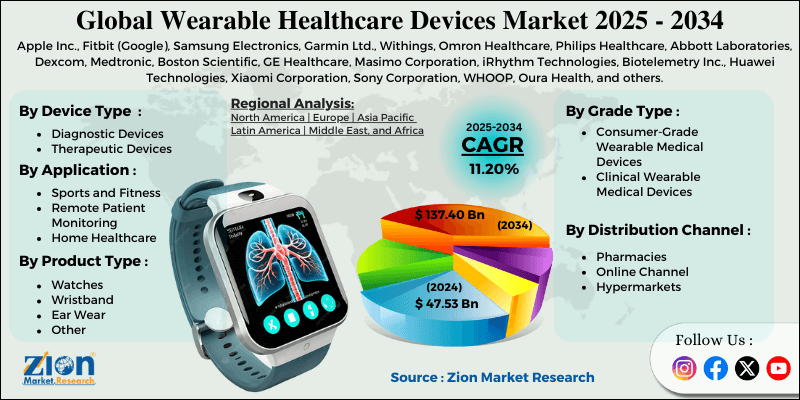
“According to the latest research study, the global wearable healthcare devices market size was valued at around USD 47.53 billion in 2024. The market is expected to grow at a CAGR of 11.20% and is anticipated to reach a value of USD 137.40 billion by 2034.”

Get a Free Sample PDF of this Research Report for more Insights - https://www.zionmarketresearch.com/sample/wearable-healthcare-devices-market
(Before you plan to buy, sample reports are a great option to examine our in-depth studies or reports)
Industry Overview:
Wearable healthcare devices refer to electronic gadgets worn on or attached to the body that continuously or periodically monitor physiological parameters, track health metrics, and sometimes deliver therapeutic interventions. These devices encompass smartwatches, fitness bands, patches, ear-worn sensors, and specialized medical-grade monitors that collect data on heart rate, sleep patterns, blood glucose, ECG, activity levels, and other vital signs, empowering users and healthcare providers with real-time insights for better health management.
The market dynamics are shaped by strong growth drivers such as the shift toward preventive healthcare and remote patient monitoring, alongside technological advancements in miniaturization and connectivity. Restraints include data privacy concerns and regulatory hurdles, while opportunities lie in specialized chronic disease management and improved reimbursement policies. Challenges involve achieving clinical-grade accuracy and addressing user engagement for long-term adoption.
Report Scope:
| Report Attribute | Report Details |
| Market Size in 2024 | USD 47.53 Billion |
| Market Forecast in 2034 | USD 137.40 Billion |
| Growth Rate | CAGR of 11.20% |
| Base Year | 2024 |
| Forecast Years | 2025- 2034 |
| Key Companies Covered | Apple Inc., Fitbit (Google), Samsung Electronics, Garmin Ltd., Withings, Omron Healthcare, Philips Healthcare, Abbott Laboratories, Dexcom, Medtronic, Boston Scientific, GE Healthcare, Masimo Corporation, iRhythm Technologies, Biotelemetry Inc., Huawei Technologies, Xiaomi Corporation, Sony Corporation, WHOOP, Oura Health, and others. |
| Segments Covered | By Device Type, By Application, By Product Type, By Grade Type, By Distribution Channel, and By Region |
| Regions Covered | North America, Europe, Asia Pacific, Latin America, and the Middle East & Africa |
| Customization Scope | Avail customized purchase options to meet your exact research needs. |
Directly Purchase a Copy of the Report | Quick Delivery Available - https://www.zionmarketresearch.com/inquiry/wearable-healthcare-devices-market
Key Insights
- As per the analysis, the wearable healthcare devices market share is likely to grow at a CAGR of around 11.20% between 2025 and 2034.
- The wearable healthcare devices market size was worth around $47.53 billion in 2024 and is estimated to hit approximately $137.40 billion by 2034. Due to a variety of driving factors, the market is predicted to rise at a significant rate.
- The market is driven by rising demand for preventive healthcare, advancements in sensor technology and AI, expansion of remote patient monitoring, increasing chronic disease prevalence, and supportive digital health policies.
- Based on the device type segment, diagnostic devices dominated due to their versatility in vital sign monitoring and expanding use in both consumer wellness and clinical applications.
- Based on the application segment, remote patient monitoring captured the largest revenue share owing to increasing telehealth adoption, chronic disease prevalence, and supportive reimbursement policies.
- Based on the product type segment, watches dominated due to their all-in-one functionality, combining health tracking with everyday utility and consumer preference for versatile devices.
- Based on the grade type segment, consumer-grade wearable medical devices accounted for the largest market share because of wider accessibility, affordability, and growing consumer health consciousness.
- Based on the distribution channel segment, the online channel is anticipated to command the largest share due to convenience, extensive product selection, and availability of detailed reviews.
- North America region is projected to dominate the global market with approximately 42% share due to high technology adoption, advanced healthcare infrastructure, and strong consumer interest in personalized health insights.
Industry Growth Drivers
What are the primary factors propelling the growth of the Wearable Healthcare Devices market?
The primary growth drivers include the expansion of digital health ecosystems and a global shift toward preventive healthcare models. Consumers and healthcare systems increasingly rely on continuous monitoring to detect issues early, manage chronic conditions, and reduce hospital visits, supported by connected platforms that integrate wearable data with electronic health records.
Technological improvements in multi-parameter sensors, AI-driven predictive analytics, and enhanced battery life enable more accurate and user-friendly devices. These advancements facilitate seamless integration into daily life while providing clinically relevant insights, thereby boosting adoption across fitness enthusiasts, patients, and elderly populations.
Restraints
What limitations are hindering the widespread adoption of Wearable Healthcare Devices?
Data security and privacy concerns remain significant restraints, as wearables collect sensitive health information that could be vulnerable to breaches, leading to consumer hesitation and increased regulatory scrutiny. Compliance with varying regional standards further complicates product development and market entry for manufacturers.
High costs of clinical-grade devices and limited reimbursement in certain markets restrict accessibility, particularly in developing regions. Additionally, variability in device accuracy across different user physiologies can undermine trust among healthcare professionals.
Browse the full “Wearable Healthcare Devices Market By Device Type (Diagnostic Devices, Therapeutic Devices), By Application (Sports and Fitness, Remote Patient Monitoring, Home Healthcare), By Product Type (Watches, Wristband, Ear Wear, Other), By Grade Type (Consumer-Grade, Clinical), By Distribution Channel (Pharmacies, Online Channel, Hypermarkets), and By Region - Global and Regional Industry Overview, Market Intelligence, Comprehensive Analysis, Historical Data, and Forecasts 2025 - 2034” Report at https://www.zionmarketresearch.com/report/wearable-healthcare-devices-market
Wearable Healthcare Devices Market: Segmentation
The wearable healthcare devices market is segmented by device type, application, product type, grade type, distribution channel, and region.
Based on Device Type, the wearable healthcare devices market is divided into diagnostic devices, therapeutic devices, and others. The most dominant segment is diagnostic devices, which lead the market due to their broad capability in monitoring vital signs, sleep, ECG, and neuromonitoring, serving both wellness and clinical needs with sophisticated app ecosystems. This dominance drives the market by enabling continuous health tracking, early detection of abnormalities, and supporting the shift from reactive to preventive healthcare models. The second most dominant segment is therapeutic devices, including pain management, rehabilitation, and respiratory therapy solutions, which contribute by providing non-invasive treatment options and improving patient outcomes in home settings.
Based on Application, the wearable healthcare devices market is divided into sports and fitness, remote patient monitoring, and home healthcare. The most dominant segment is remote patient monitoring, holding the largest revenue share because of accelerating telehealth adoption, rising chronic disease burden, potential cost savings for healthcare systems, and favorable reimbursement policies. This leadership drives the market by facilitating real-time data sharing between patients and providers, reducing hospital readmissions, and enabling personalized care at scale. The second most dominant segment is sports and fitness, supported by growing consumer focus on active lifestyles and performance optimization.
Based on Product Type, the wearable healthcare devices market is divided into watches, wristband, ear wear, and others. The most dominant segment is watches, leading due to their comprehensive functionality, stylish design, and ability to combine health monitoring with communication and lifestyle features. This dominance propels the market by appealing to a wide consumer base and encouraging frequent upgrades through seamless integration with smartphones and health platforms.
Based on Grade Type, the wearable healthcare devices market is divided into consumer-grade wearable medical devices and clinical wearable medical devices. The most dominant segment is consumer-grade wearable medical devices, which hold the largest share owing to greater affordability, ease of availability, and rising health awareness among general consumers. This position drives market growth by democratizing access to health tracking technology and creating a large entry-level user base that later upgrades to advanced solutions.
Based on Distribution Channel, The Wearable Healthcare Devices market is divided into pharmacies, online channel, and hypermarkets. The most dominant segment is online channel, anticipated to lead due to convenience, wide product variety, transparent consumer reviews, and global reach. It drives the market by simplifying purchasing decisions and supporting direct-to-consumer models that accelerate adoption.
Regional Scope:
Why will North America continue to dominate the global market during the projection period?
North America is expected to maintain its leadership in the global Wearable Healthcare Devices market throughout the forecast period. The region benefits from high technology adoption rates, substantial healthcare expenditure, and a well-developed digital health infrastructure that supports seamless integration of wearable data. Strong consumer interest in personalized health insights, combined with advanced insurance models favoring preventive monitoring, fuels demand. High per capita usage and frequent device replacement cycles further sustain growth. The United States dominates as the largest adopter, driven by innovation hubs, a favorable regulatory environment for digital health, and the active participation of technology and medical device companies. Public awareness campaigns and corporate wellness initiatives also contribute to robust market expansion in the region.
Europe holds a significant position supported by aging populations, public healthcare systems, and an emphasis on evidence-based medicine. Countries like Germany, the UK, and France lead through privacy-focused regulations and integration of wearables into chronic care pathways. Asia Pacific is emerging rapidly with rising disposable incomes, smartphone penetration, and government initiatives promoting digital health in nations such as China, India, and Japan. Latin America and the Middle East & Africa show steady progress, driven by increasing chronic disease awareness and gradual infrastructure improvements, though challenges in affordability and connectivity persist.
Request For Customization - https://www.zionmarketresearch.com/custom/9504
Recent Developments
- In March 2025, a Mayo Clinic study involving over 10,000 patients demonstrated that wearable ECG monitoring detected 35% more cases of atrial fibrillation compared to traditional methods, highlighting the clinical value of continuous monitoring.
Wearable Healthcare Devices Market: Competitive Landscape
The report contains qualitative and quantitative research on the global wearable healthcare devices market, as well as detailed insights and development strategies employed by the leading competitors.
Some of the leading players in the global wearable healthcare devices market include;
- Apple Inc.
- Fitbit (Google)
- Samsung Electronics
- Garmin Ltd.
- Withings
- Omron Healthcare
- Philips Healthcare
- Abbott Laboratories
- Dexcom
- Medtronic
- Boston Scientific
- GE Healthcare
- Masimo Corporation
- iRhythm Technologies
- Biotelemetry Inc.
- Huawei Technologies
- Xiaomi Corporation
- Sony Corporation
- WHOOP
- Oura Health
What are the key trends in the Wearable Healthcare Devices Market?
Integration of AI and predictive analytics
Wearable devices are increasingly incorporating artificial intelligence to deliver actionable health insights, early risk detection, and personalized recommendations, shifting from simple tracking to intelligent health companions.
Growth of remote patient monitoring and clinical integration
There is a clear trend toward using wearables for continuous remote monitoring of chronic conditions, supported by healthcare providers and reimbursement policies, bridging consumer wellness with clinical applications.
The global wearable healthcare devices market is segmented as follows:
By Device Type
- Diagnostic Devices
- Therapeutic Devices
By Application
- Sports and Fitness
- Remote Patient Monitoring
- Home Healthcare
By Product Type
- Watches
- Wristband
- Ear Wear
- Other
By Grade Type
- Consumer-Grade Wearable Medical Devices
- Clinical Wearable Medical Devices
By Distribution Channel
- Pharmacies
- Online Channel
- Hypermarkets
By Region
- North America
- The U.S.
- Canada
- Europe
- France
- The UK
- Spain
- Germany
- Italy
- Rest of Europe
- Asia Pacific
- China
- Japan
- India
- Southeast Asia
- Rest of Southeast Asia
- The Middle East & Africa
- GCC
- South Africa
- Rest of the Middle East & Africa
- Latin America
- Brazil
- Argentina
- Rest of Latin America
Request Free Brochure @ https://www.zionmarketresearch.com/requestbrochure/wearable-healthcare-devices-market
Key Questions Answered in This Report:
- What is wearable healthcare devices?
- Which key factors will influence the wearable healthcare devices market growth over 2025-2034?
- What will be the value of the wearable healthcare devices market during 2025-2034?
- What will be the CAGR value of the wearable healthcare devices market during 2025-2034?
- Which region will contribute notably towards the wearable healthcare devices market value?
- Which are the major players leveraging the wearable healthcare devices market growth?
- What can be expected from the global wearable healthcare devices market report?
Key Offerings:
- Full in-depth analysis of the parent market
- Important changes in market dynamics
- Segmentation details of the market
- Previous, ongoing, and projected market analysis in terms of volume and value
- Assessment of niche industry developments
- Market share analysis
- Key strategies of major players
- Emerging segments and regional markets
- Testimonials to companies in order to fortify their foothold in the market
Browse Other Related Research Reports
- Ligating Clips Market By Type (Polymer Ligating Clips, Hemostatic Ligating Clips, Metal Ligating Clips, and Others), By Application (Surgery, Vascular Ligations, Endoscopy, and Others), By End-User (Hospitals and Clinics, Research Institutes, Ambulatory Surgical Centers, and Others), and By Region - Global and Regional Industry Overview, Market Intelligence, Comprehensive Analysis, Historical Data, and Forecasts 2025 - 2034
- Antiemetics Market By Indication (Motion Sickness, Chemotherapy-Induced Nausea, Pregnancy-related Nausea, Postoperative Nausea & Vomiting, and Radiation-Infused Nausea), By Route of Administration (Rectal, Transdermal, Oral, Intravenous, and Subcutaneous), and By Region - Global and Regional Industry Overview, Market Intelligence, Comprehensive Analysis, Historical Data, and Forecasts 2025 - 2034
- Pitavastatin Market By Type (1mg, 2mg, and 5mg), By Product (Capsules, Tablets, and Oral Solutions), By Application (Cardiovascular Disease Prevention and Hyperlipidemia), By Sales Channel (Online Pharmacies, Retail Pharmacies, Clinics, and Hospitals), and By Region - Global and Regional Industry Overview, Market Intelligence, Comprehensive Analysis, Historical Data, and Forecasts 2025 - 2034
- Disposable Protective Clothing Market By Material (Polyethylene, Polypropylene, Polyester, and Others), By Application (Thermal, Chemical, Mechanical, Biological/Radiation, Visibility, and Others), By End-Use Industry (Oil & Gas, Construction, Manufacturing, Healthcare/Medical, Mining, Defense & Public Safety, and Others), and By Region - Global and Regional Industry Overview, Market Intelligence, Comprehensive Analysis, Historical Data, and Forecasts 2025 - 2034
- Outpatient Care Market By Service Type (Ambulatory Surgical Centers (ASCs), Diagnostic Imaging Centers, Specialty Clinics, Urgent Care Centers, Family Planning Centers, Outpatient Mental Health, Primary Care Clinics, and Others), By Application (Hospitals, Ambulatory Surgical Centers, and Others), By Expenditure Type (Public and Private), and By Region - Global and Regional Industry Overview, Market Intelligence, Comprehensive Analysis, Historical Data, and Forecasts 2025 - 2034
- Cupping Devices Market By Product Type (Manual Cupping Devices, Electrical Cupping Devices, Mechanical Cupping Devices, Silicone Cupping Devices, and Others), By Application (Pain Management, Respiratory Issues, Skin Care, Digestive Disorders, and Others), By End-User (Hospitals, Clinics, Spas and Wellness Centers, and Home Use), and By Region - Global and Regional Industry Overview, Market Intelligence, Comprehensive Analysis, Historical Data, and Forecasts 2025 - 2034
- Acute Care Providers Market By Facility (General Acute Care Hospitals, Psychiatric Hospitals, Specialized Hospitals, Rehabilitation Hospitals, and Long-Term Acute Care Units), By Medical Condition (Emergency Care, Trauma Care, Acute Care Surgery, Short-term Stabilization, and Others), By Service Type (Intensive Care Unit (ICU), Coronary Care Unit (CCU), Neonatal Intensive Care Unit (NICU), Emergency Room/Urgent Care Services, and Others), By Delivery Mode (Inpatient Acute Care, Outpatient Emergency/Urgent Care, Telehealth/Virtual Acute Care Services and Ambulatory Surgery Centers (ASC)), and By Region - Global and Regional Industry Overview, Market Intelligence, Comprehensive Analysis, Historical Data, and Forecasts 2025 - 2034
- Air Ambulance Services Market By Service Type (Medical Evacuation, Medical Repatriation, Organ Transport, Neonatal and Pediatric Transport, Disaster Response, and Others), By Aircraft Type (Helicopters, Fixed-Wing Aircraft), By End-User (Hospitals, Insurance Companies, Governments, Private Individuals, Military), By Application (Emergency Medical Services, Patient Transfer, Specialty Care Transport, Disaster Relief), and By Region - Global and Regional Industry Overview, Market Intelligence, Comprehensive Analysis, Historical Data, and Forecasts 2025 - 2034
About Zion Market Research:
Zion Market Research is a leading market research organization offering industry expertise and scrupulous consulting services to clients for their business development. The reports and services offered by Zion Market Research are used by prestigious academic institutions, start-ups, and companies globally to measure and understand the changing international and regional business backgrounds.
Contact Us:
Zion Market Research
USA/Canada Toll Free: 1 (855) 465-4651 | Newark: 1 (302) 444-0166
India: +91 7768 006 007 | +91 7768 006 008
Email: sales@zionmarketresearch.com | Web: https://www.zionmarketresearch.com/
Follow Us on - LinkedIn | X | Facebook | Pinterest | YouTube


Legal Disclaimer:
EIN Presswire provides this news content "as is" without warranty of any kind. We do not accept any responsibility or liability for the accuracy, content, images, videos, licenses, completeness, legality, or reliability of the information contained in this article. If you have any complaints or copyright issues related to this article, kindly contact the author above.
